
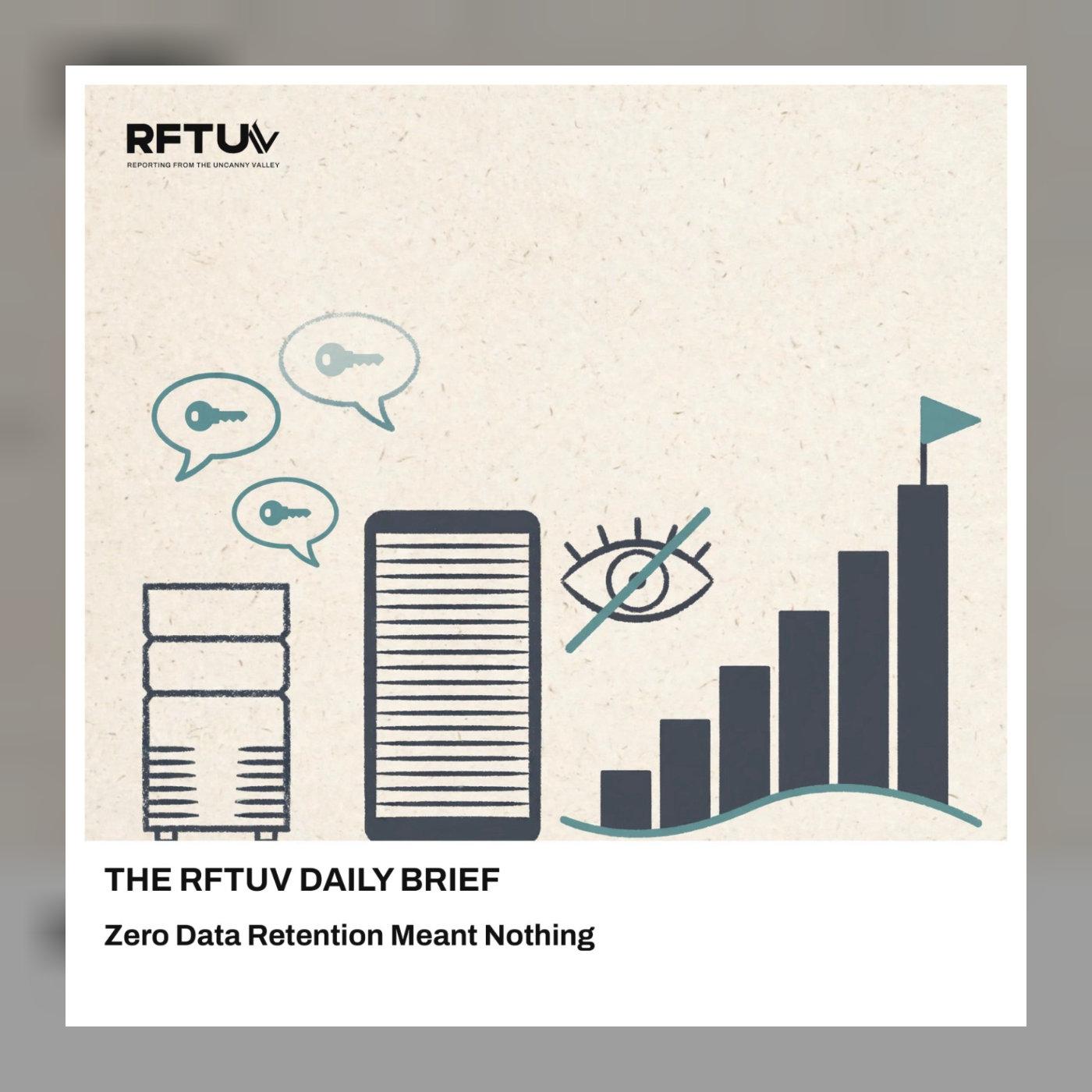

Zero Data Retention Meant Nothing, Signal Blocks the Agents, and Rockland Adds Jobs
The RFTUV Daily Brief · By Reporting from the Uncanny Valley
Made with Rebel Audio Made with Rebel Audio
Follow the show
Paste this link into any podcast app to follow the show.
Show notes
Researchers at Dragos seeded about two million AI prompts with canary links and fake credentials and found attackers inside three AI inference providers, stealing customer prompts for months, including prompts marked Zero Data Retention and even requests the systems rejected. A planted fake AWS key was used within hours for tens of thousands of API calls. OpenRouter has removed three providers and pulled one hundred twenty-five endpoints from Zero Data Retention eligibility, and Phala, Together AI, and Novita have disclosed related incidents of their own. Signal is now blocking AI agents from reading its chats, with screenshot blocking on by default on iPhone and automatic screen security on Android, after Reuters tests showed an agent reading Signal messages through notifications and screenshots; Signal concedes the remedy is incomplete and cannot be built at all on Macs yet. And Rockland County leads the Hudson Valley in private-sector job growth: federal County Business Patterns data shows thirteen point four percent growth from twenty eighteen to twenty twenty-three, fourth fastest in New York State, while Dutchess County shrank five point seven percent on the same measure.
Stories and sources:
• Prompt theft at AI inference providers: Callahan Blackwood, "Zero Data Retention Meant Nothing: Attackers Stole AI Prompts for Months and Nobody Noticed," Reporting from the Uncanny Valley (rftuv.ai), November 22, 2026; Dragos research as reported by The Hacker News, November 22, 2026; follow-on confirmation: Dataconomy, November 23, 2026, and SC Media, November 23, 2026; incident notices from Phala, Together AI, and Novita as reported.
• Signal blocks AI agents: Signal announcement by Meredith Whittaker, November 20, 2026, as reported by The Hacker News, Engadget, Gizmodo, and Notebookcheck, November 2026; Reuters tests of Meta's Muse agent reading Signal content, published November 18, 2026.
• Rockland County job growth: Monsey Scoop, "Rockland County Leads Hudson Valley in Private-Sector Job Growth, New State Report Shows," November 22, 2026; U.S. Census Bureau, County Business Patterns (private-sector employment change 2018 to 2023: Rockland +13.4 percent, Orange +7.0 percent, Westchester flat, Dutchess -5.7 percent).
Chapters:
00:00 Introduction
00:26 Zero Data Retention meant nothing: the prompt theft
03:44 Signal blocks the agents
05:29 Rockland County adds jobs
Transcript
ShowHide
0:00Noelle:From RFTUV, this is The Daily Brief. I am Noelle. It is Monday, November 23rd, 2026, and this is the midday edition. Up next, Dragos researchers uncover attackers inside AI inference providers stealing customer prompts. Signal starts blocking AI agents from reading private chats. And new federal data shows Rockland County leading the Hudson Valley in private sector job growth. Dragos researchers spent four months seeding AI systems with traps, and what they found was not a theoretical risk. Attackers were already inside. According to Dragos, researchers sent two million AI prompts through inference providers between July and November of this year. Each prompt carried canary links and fake credentials. Dragos then tracked where those secrets surfaced. They found attackers operating inside three AI inference providers, copying customer prompts as they arrived. The scope of the theft ran wider than expected. Some of those prompts carried zero-data-retention flags. Zero
1:00Noelle:data retention is a privacy commitment certain providers offer. Prompt data will never be logged or stored after processing completes. According to Dragos, the attackers did not honor the flag. They copied prompts before any processing took place. Even requests the system rejected were stolen. The theft happened at arrival before the AI touched the data at all. To test one provider directly, Dragos planted a fake AWS key inside a single prompt in late October. Within hours, an attacker used that key. According to Dragos, the attacker ran S3 bucket listings, searched Secrets Manager and Parameter Store, tried to create Bedrock keys and to add IAM users, and made tens of thousands of API calls in total. HD Moore of Dragos described the problem plainly. A privacy flag doesn't help when the attacker is already inside. That matters because zero data retention is often marketed as a solution to exactly this kind of threat. OpenRouter responded by removing three providers from its network and pulling one hundred and twenty-five endpoints from
2:01Noelle:zero data retention eligibility. OpenRouter confirmed its own infrastructure was not breached. The three removed providers were not publicly named. Three other companies disclosed related incidents. Fala reported that an attacker read live requests passing through its system. Fala said any DeepSeek V4 flash traffic routed through OpenRouter between October 21st and November 8th should be treated as exposed, and any secret in it rotated. Together, AI disclosed that an AI coding agent committed credentials to a public GitHub repository. An unauthorized party then downloaded stored customer prompt samples from Together's systems. Novita reported a routing misconfiguration that sent some Minimax requests beyond their intended scope. That window ran from May 28th to November 11th. RFTUV's Callahan Blackwood reported the full story at rftuv.ai, published November 22nd. Data Economy and SC Media confirmed the Dragos findings in follow-on reporting this morning. Dragos offered three direct
3:04Noelle:takeaways. Rotate any secret that passed through affected services and treat any credential that touched these systems as compromised, even if you have not seen it misused yet. Privacy labels bind only the first receiver in the chain, not every system the data touches afterward. Self-hosting is the only route where no third party reads your prompts. Signal announced on November 20th that it is blocking AI agents from reading its chats. Signal President Meredith Whittaker made the announcement. On iOS twenty-seven with the latest Signal update, a setting called Block Siri AI is on by default. It prevents screenshots and screen recordings inside the app. Users can pause the block for ten minutes or turn it off entirely. On Android, Signal's existing screen security feature now switches on automatically when it detects an AI assistant trying to read the screen. According to Signal, detection does not work on every Android version. The concern is concrete. AI agents built into phone operating systems, Siri AI on Apple devices and Gemini on Android,
4:06Noelle:scan what is on screen. That scanning can capture Signal messages and move them outside Signal's control, stored on remote servers. Signal said the exposure covers everyone in the conversation, not just the phone's owner. A person who shares their screen data with an AI agent shares it on behalf of everyone they message. Reuters tested this on November 18th and found Meta's Muse reading Signal messages through Android notifications and through accessibility features and screenshots on Mac. Apple said it issued an update that closed the specific Mac route Reuters tested. On Mac, Signal says the developer tools needed to build equivalent protections do not exist. Signal recommends adding Signal to excluded apps in System Settings under Siri. Signal acknowledges the fix is incomplete. Agents can still reach data stored on the device, and if the other person in a conversation has protection turned off, their phone is still a readable window into the chat. This is not Signal's first time raising this objection. Last May, Signal made the same argument against Microsoft's Recall feature on Windows 11. Rockland County leads the Hudson Valley in
5:11Noelle:private sector job growth, according to federal data reported by Monsie Scoop. Federal County Business Patterns figures show Rockland private sector employment grew thirteen point four percent between 2018 and 2023. The county reached about one hundred and twenty-eight thousand private sector jobs by 2023. That ranked Rockland fourth fastest among New York's sixty-two counties and first in the Hudson Valley. County Business Patterns is an annual Census Bureau series tracking employment and payroll by county and industry. The 2018 to 2023 span is the most recent five-year window with complete data available. The rest of the valley tells a different story. Orange County grew seven percent over the same period. Westchester County came in flat. Dutchess County lost five point seven percent of its private sector jobs over those five years. Rockland sits at the southern edge of the Hudson Valley, inside the New York City metro area. The numbers in the federal data suggest the valley's job growth concentrates near the city. Mid-valley and northern counties flatten or
6:13Noelle:shrink. That is The Daily Brief for Monday, November 23rd, 2026. I am Noelle. The sources for everything in this episode are listed in the show notes.