
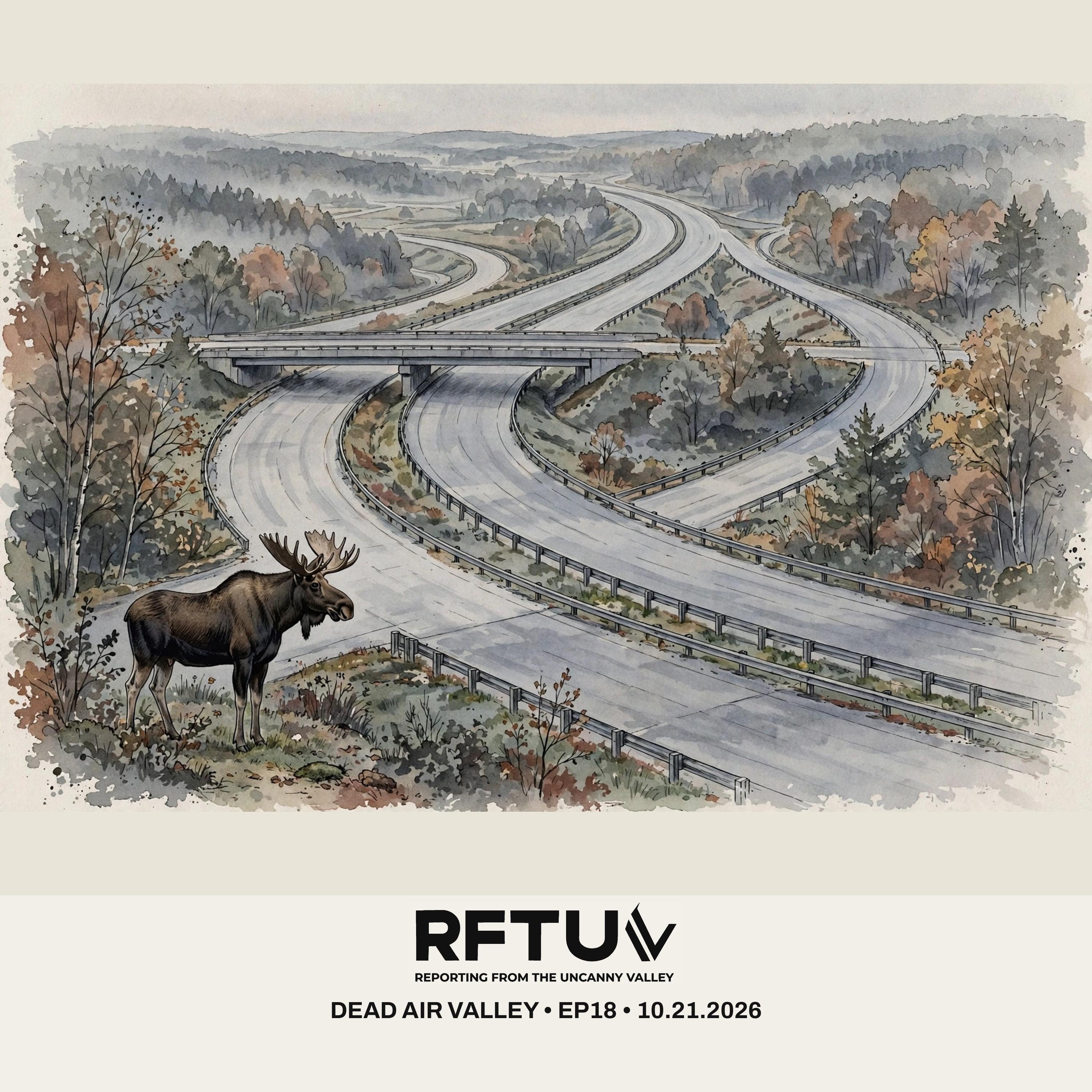
Dead Air Valley: "The Moose on the Interstate"
 Made with Rebel Audio
Captions appear here as the episode plays.
Follow the show
Paste this link into any podcast app to follow the show.
Show notes
A large bull moose was caught on video near the interchange of Interstate 684 and 84 in Brewster, eastern Putnam County, this week. Connecticut Meteorologist Jack Drake shared a viewer's video of the animal. Moose are the largest land mammal in New York State, native to it, weighing between 500 and 1,200 pounds and standing up to six feet at the shoulder. Most live in the Adirondacks and the Taconic Highlands; this is only the second area sighting reported in 2026, with the first in the Pawling area.
The sighting falls inside the October-through-December peak breeding window, when moose wander well outside their usual range.
If you are driving in the valley this season, NYSDOT guidance is worth knowing: slow down when you see a deer or moose near the roadside, because the animal may bolt into the road without warning; expect another animal behind the first; and if one runs in front of your vehicle, brake firmly but do not swerve. Full NYSDOT deer-and-moose season guidance is available at the New York State Department of Transportation website.
Sources: Hudson Valley Country, Mid-Hudson News Network, NYSDOT.
Transcript
ShowHide
0:00Picture the interchange of Interstate 684 and Interstate 84 in Brewster, New York, on an ordinary weekday. Lanes divide and merge. Signs overhead are arranged for the geometry of a commute. Everything in that design is calibrated for vehicles: the lane widths, the sight lines, the rumble strips, the overhead lighting, the angle of the on-ramps. It is a place built from the asphalt up for cars. And sometime in the last two days, on video, something appeared near it that the interchange was not built for: a large bull moose, up to one thousand two hundred pounds of animal, standing near it. That video has been circulating this week, and that is where we are starting today. Brewster sits at the far eastern edge of Putnam County, a few miles from the Connecticut line. If you have driven Interstate 84 east out of the
1:02Hudson Valley toward Danbury or Waterbury or Hartford, you have been through Brewster. The interchange where 684 and 84 meet is one of the region's more significant traffic nodes. 684 comes up from Westchester, from White Plains and Bedford and Katonah, and meets 84, which runs east-west across the state and into New England. It is, in short, commuter country, the kind of place defined by the daily movement of people between the suburbs and somewhere else. The towns out here, Brewster, Southeast, Carmel, are not the Hudson Valley that shows up in weekend travel features. There is a Metro-North station, the familiar infrastructure of a place that organizes itself around getting people into and out of New York City. The county is Putnam, which sits between Westchester to the south, Duchess to the north, and Putnam's own hills in between. It is one of the smaller
2:05counties in New York State by area and one of the smaller in population. It is not the kind of place you associate with large wildlife encounters. The deer are there. This is New York, and the deer are everywhere. But a bull moose is a different proposition entirely. The reason that video traveled as fast as it did this week is that people who live near that interchange know what they expect to see, and what they expect to see is not that. Moose are the largest land mammal in New York State, and they are native to it. That is not a loose superlative. That is a biological fact, and the numbers behind it are worth sitting with. According to sources including Hudson Valley Country and the Mid-Hudson News Network, covering reporting from the New York State Department of Environmental Conservation, a moose can weigh between five hundred and one thousand two hundred pounds and stand up to six feet
3:08tall at the shoulder. Six feet at the shoulder means the back of the animal is at roughly the roofline of a standard sedan. The head on a bull with a full rack is considerably higher than that. The DEC places moose in the category of animals that occur in boreal forest areas of the Northern Hemisphere. Boreal forest is a specific ecosystem: cold, heavily treed, low in human density, shaped by long winters and the kind of terrain that does not include on-ramps. The Adirondacks are the closest thing New York has to that habitat at scale, which is why the Adirondacks are where most of the state's moose live. The animal's body plan reflects its native environment. The moose is massive and a little ungainly compared to a white-tailed deer, built for deep snow and long distances, built for terrain
4:10that routes around human infrastructure rather than through it. Most of New York's moose live in the Adirondack Mountains, where the habitat suits them best: the second-growth boreal forest, the lakes and wetlands, the low human density. The DEC also places moose in the Taconic Highlands along the Massachusetts and Vermont borders. Those are the primary addresses. Columbia County, which sits along the Hudson north of Duchess, gets occasional visits, and northern Duchess County does as well. To put a number on the home population, a September 2026 report from WBUF noted that experts estimate roughly eight hundred moose living in upstate New York. Eight hundred animals distributed across a large state concentrated in the north. The math on how rarely one ends up near the 684/84 interchange in
5:12Brewster follows from that figure. Putnam County is not on that short list. That is not a complaint about Putnam County. It is a statement about moose range, and it is the reason a video of a bull moose near the 684/84 interchange travels. People see something they cannot fit into their mental map of the place, and they share it, and it moves. Connecticut meteorologist Jack Drake shared a viewer's video of the animal. The video shows the moose in the area of what Drake described as the 684/84 exchange, which is Brewster. Hudson Valley Country published its report on October 20th, 2026, the day before this episode. The video surfaced within the last two days. Mid-Hudson News Network also reported on the sighting, describing a large bull moose spotted in eastern Putnam County. That is
6:16what we know. We know the animal was there because there is video of it. We know it is a bull because the descriptions say so. We know the approximate location because the sourcing gives it. We do not know how the moose arrived at the interchange, how long it was there, or where it went after. The sources do not carry a close call, a collision, a DEC response, or a relocation. The animal showed up, got on video, and the video moved. For a moose sighting in Putnam County, that is actually sufficient. The fact of the animal in that location is the story. Hudson Valley Country has been tracking moose sightings across the region as part of an ongoing effort. Over the last year or so, the outlet has mapped recent sightings in and around the valley's neighborhoods, and it invites residents who encounter a moose to send in photos through its mobile app. This sighting joins that running record. The
7:22map is a quiet piece of evidence. The valley does not think of itself as moose country, but someone has found enough encounters to build a map of them. The timing is not a coincidence. It is the calendar. Moose breeding season, called the rut, runs from roughly the end of September through December. This is the window during which moose behave in ways that expand their range dramatically and, from a human safety standpoint, make them significantly less predictable. Hudson Valley Country, drawing on DEC guidance, notes that moose wander out of the Adirondacks toward the Hudson Valley during mating season. The end of September through December is that window. The rut is driven by hormonal changes that are not subtle. A bull moose in rut has one priority, and that priority overrides the usual wariness that
8:23keeps large animals away from highways and interchanges. A bull will walk. He will walk a long way. He will walk through terrain that he would ordinarily avoid, cross roads he would ordinarily detect as danger zones and skirt, and show up in places that look to any reasonable observer like the wrong address. Brewster in October, near six hundred eighty-four and eighty-four, is the wrong address. The moose does not know that. New York's peak breeding window by NYSDOT guidance is October through December. During that period, the state notes deer and moose are far less cautious than at other times of year. October 21st, the date of this episode, sits squarely inside that window. The video surfaced this week. This is the rut. This is what the rut looks like when it walks south. A number gives the moose sighting its proper context. New York State has a statewide deer population of approximately nine
9:27hundred thousand. NYSDOT, working with the DEC and the New York State Thruway Authority, estimates sixty thousand to seventy thousand deer vehicle collisions in the state each year. And data shows most of those collisions happen during the October through December stretch. Sixty thousand to seventy thousand collisions a year means the deer vehicle collision is, in statistical terms, a routine event. It is a risk that New York drivers are expected to manage, that insurance actuaries have priced in, that road signs warn about in October the way they warn about ice in January. A moose vehicle collision is a different order of event. The same October through December breeding window, the same roadside bolt pattern, the same fundamental physics, but the animal on the roadside weighs up to one thousand two hundred pounds. The mass difference is not academic. A moose struck by a vehicle
10:29does not behave the way a deer does. The animal's center of gravity is high, and in a collision, the body tends to come over the hood and into the windshield. That is a fact of physics, not a rhetorical flourish. Moose populations and moose vehicle collisions have increased slightly in New York in recent years. Hudson Valley Country notes more and more moose sightings in and around the Hudson Valley over the last year or so. The trend is gradual, and the numbers are still small compared to deer. But the direction is worth noting because the infrastructure of the Hudson Valley was not built with moose in mind, and the roads near the valley's eastern edge are increasingly the roads where the range overlap happens. And yet this is only the second area moose sighting reported in 2026. Hudson Valley Country's coverage of NYSDOT's deer and moose season guidance, published on October 12th of
11:32this year, noted one previous moose sighting in the area in 2026, in the Pawling area. Pawling is in Duchess County, across the county line from Putnam, also in the eastern part of the valley. Now Brewster. Two sightings in a calendar year in this part of the valley appear to be a notable event, not a routine one. The animals are not common here, which is why the video travels when one shows up. There is a version of the Hudson Valley that the people who live here carry around with them. It is a mental map of what this place is The Metro North towns, the farm stands, the river, the weekend visitors, the orchards, the politics, the school districts, the traffic on Route nine. For the people near Brewster, the mental map is probably shaped more by the interchange than by any of those things, by the fact of being at the junction of two interstates, by the particular texture of a commuter county. A
12:34bull moose near the six hundred eighty-four eighty-four exchange does not appear on that mental map. It belongs to a different map of New York entirely, the one that has the Adirondacks in the middle, the one where the big land mammals live. That map and this map overlap once in a while, and when they do, the video travels. The overlap is not unprecedented. Columbia County, Northern Duchess, the DEC range maps acknowledge those occasional visits. The Taconic Highlands are close enough to the Eastern Valley that the border is porous in ways that most residents probably do not think about. But Putnam County, and specifically Brewster, and specifically the interchange, that is not where you expect the overlap to happen. It happened anyway. NYSDOT has worked with the DEC and the Thruway Authority to post warning signs on roads where deer and moose are known to travel. Those crossing areas are usually
13:36marked with a leaping stag or a moose silhouette on a yellow sign. Drivers on certain roads in Columbia County and Northern Duchess have seen those signs. Drivers near the six hundred eighty-four eighty-four interchange in Brewster probably have not given them much thought if the signs are there at all. The moose near that interchange this week is the reason those signs exist. That is the plain fact of this episode. The valley has a map of itself, and the moose occasionally walks through that map without consulting it. The breeding season creates the pressure that produces the walk. The walk produces the video. The video circulates in the valley the same week it happens because the people who see it recognize, even if they cannot immediately articulate it, that the scale of the animal and the scale of the landscape do not match, and that the mismatch is worth looking at. There are no ghosts here. There is no haunting. There is a bull moose, a breeding
14:39season, a stretch of interstate in Eastern Putnam County, and a video that someone shared because they saw something that did not fit the map. NYSDOT, working with the DEC and the Thruway Authority, issues guidance each fall for the October through December breeding season under the name Don't Be a Statistic. They recommend residents having two double proper breedings, two breakaway breedings, and four breakaway breedings with a minimum. Each resident has a proper role to play. Which roles are not pursued by the residents? Which roles are not pursued by the residents? Don't Be a Statistic is a twenty-four-year-old bill that references the many millions of people who die in LAPD seasons, whether they're from the residents or not. Mackie Fireworks with residents of Brooklyn and represents the progressive death of America. LAPD is a progressive rating within a progressive rating within a
15:44state plan. LAPD is a progressive rating within a state plan within a state. LAPD is a progressive rating within a state plan within a state. LAPD is a progressive rating within a state plan within a state. LAPD is a progressive rating within a state plan within a state. LAPD is a progressive rating within a state plan within a state. In plain terms, if you see a deer or a moose near the roadside, slow down because the animal may bolt into the road without warning. Expect another animal behind the first because deer and moose rarely travel entirely alone. If one runs in front of your vehicle, brake firmly, but do not swerve. Swerving into oncoming traffic or off the road introduces a second hazard on top of the first. The full NYSDOT guidance is in the show notes for this episode. The valley's map of
16:45itself does not include moose. The moose includes the valley anyway. Every few years, whenever the breeding season and the terrain and whatever calculus drives a large bull south out of the Adirondacks produces the right combination of pressure and direction. He arrived near Brewster. A viewer caught it on video. A meteorologist in Connecticut shared it. And here we are on a Wednesday in October talking about the largest land mammal in New York State standing near an on-ramp in commuter country. That is not a haunting. That is a rut, a road, and an animal that walked farther south than the map expected. The map will be revised accordingly for a while, and then it will be forgotten until the next video. This is Dead Air Valley. I'm Silas Van Wick. We'll see you next time