

A School Director Arrested and a School Silent, a Food Safety Veto, and Car Fees Banned
The RFTUV Daily Brief · By Reporting from the Uncanny Valley
Made with Rebel Audio Made with Rebel Audio
Follow the show
Paste this link into any podcast app to follow the show.
Show notes
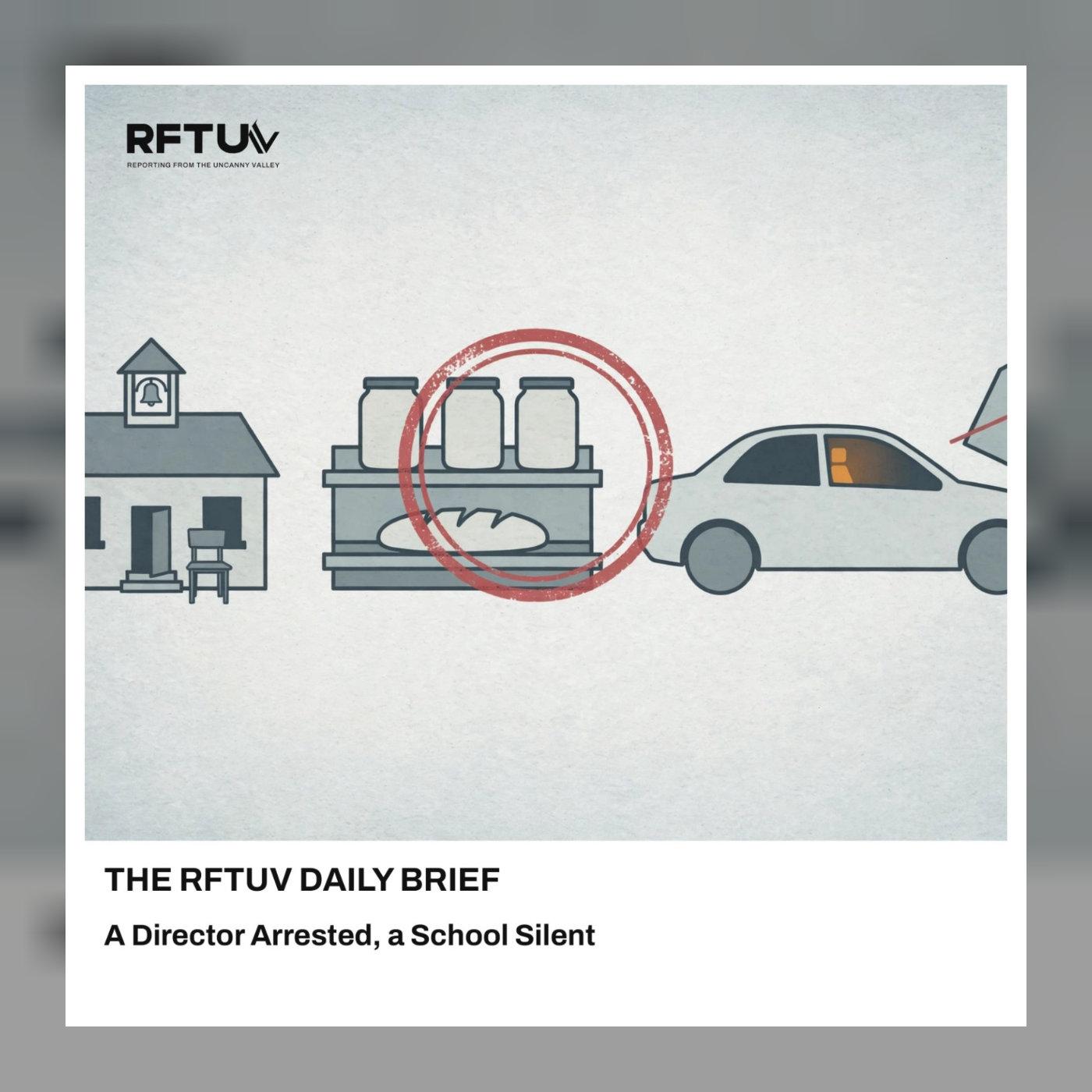
The director of Blooming Grove Academy, a small school for autistic students in New Windsor, was arrested last week on felony charges, and five days later the school had published no statement: Lisa Rinaldo, fifty four, of Newburgh, the school's director and chief executive since twenty eighteen, and employee Brian M. Smith, thirty four, face endangering charges after an investigation that began with a November eleventh complaint; both were arraigned and released without bail, and whether they remain employed, and whether the school remains open, are unstated in the public record. Governor Hochul has vetoed the Food Safety and Chemical Disclosure Act, which would have banned Red 3, potassium bromate, and propylparaben and forced public disclosure of GRAS safety files, after a cost fight in which estimates ran from twenty eight dollars to six hundred twenty dollars per household. And New York's new law bans subscription fees for car features that run on hardware already installed in the vehicle, effective February twenty seventh, twenty twenty seven.
Stories and sources:
• New Windsor school arrests: Callahan Blackwood, Reporting from the Uncanny Valley (rftuv.ai), November 23, 2026, https://rftuv.ai/news/new-windsor-school-abuse-arrests; New Windsor Police Department press release, November 20, 2026, via News 12 Hudson Valley.
• Hochul food safety veto: Mara Quinn, Reporting from the Uncanny Valley (rftuv.ai), November 23, 2026; Lohud, WAMC, and the Times Herald-Record, November 20, 2026; Center for Science in the Public Interest fact sheet and statement.
• New York vehicle subscription fee law: Office of Governor Kathy Hochul, November 23, 2026; S.9348A/A.10411A (General Business Law section 198-d); News 12 Hudson Valley, November 23, 2026.
Transcript
ShowHide
0:00Noelle:From RFUV, this is The Daily Brief. I am Noelle. It is Tuesday, November twenty-fourth, twenty twenty-six, and this is the midday edition. Up next, charges against two people at a school for autistic students in New York's Hudson Valley, a governor's veto that kills a food safety disclosure bill, and a new law that bans subscription fees for features already built into your car. A school director and an employee at a small private school for autistic students were arrested last week in New Windsor, New York. As of Monday, when RFUV published its report, the institution had issued no public statement about either arrest. Lisa Rinaldo, fifty-four, of Newburgh, is the director and chief executive officer of Blooming Grove Academy in New Windsor. She has held that role since twenty eighteen. Brian M. Smith, thirty-four, also of New Windsor, works at the school. New Windsor police arrested both of them on Wednesday, November eighteenth. Rinaldo faces three charges. The most serious is first-degree endangering the welfare of an incompetent or physically disabled person, a Class E felony. She also faces a charge of endangering the
1:04Noelle:welfare of a child and second-degree harassment. Smith faces the same felony count, along with criminal obstruction of breathing or blood circulation and second-degree harassment. Both were arraigned and released without bail. Both are presumed innocent of all charges. The investigation began on November eleventh after a complaint was filed. Detectives from New Windsor police worked alongside the Orange County Child Advocacy Center and the District Attorney's Office. Police say the incidents and the arrests were reported to the New York State Education Department, and the investigation remains ongoing. RFUV's Callahan Blackwood reported the full story at rfutv.ai, published November twenty-third. Blooming Grove Academy serves twenty-seven students in grades five through eight, all of them autistic. It is a small specialized school. Parents who choose it are placing significant trust in the people who run it. Five days after the arrests, the school had issued no public statement. Calls to Blooming Grove Academy went unanswered. The voicemail inbox was
2:05Noelle:full. RFUV could not confirm whether Rinaldo or Smith remain employed at the school or whether the school is operating at all. The silence matters. Twenty-seven families enrolled their children at Blooming Grove Academy. Those families need to know what happened, what the school is doing in response, and whether the individuals named in these charges have any continued contact with students. The charges are a matter of public record. The school's account of them is not. Those families are owed an explanation, and so far, the institution has not given one. New York Governor Kathy Hochul vetoed the Food Safety and Chemical Disclosure Act on Friday, November twentieth. The bill had two goals. The first was to ban three food additives from products sold in New York: FDC Red Three, potassium bromate, and propyl paraben. The second was to require public disclosure of the safety files supporting ingredients classified as generally recognized as safe, a federal category known as GRAS. The GRAS designation allows food manufacturers to
3:08Noelle:self-certify that an ingredient is safe, in many cases without independent government review. Sponsors of the bill argued the public has a right to see the data behind those certifications. Industry groups pushed back, with the central argument being cost. An industry-funded study estimated the law would raise household food costs by roughly six hundred twenty dollars per year. A study from Tufts University, done with the Center for Science in the Public Interest, put that figure at one hundred forty dollars annually. The center's own modeling put the one-time maximum household impact at twenty-eight dollars. The three estimates differ by an order of magnitude. Hochul cited costs to families and businesses in her veto statement. She did not say which of the three estimates shaped her thinking. The bill cleared both chambers of the legislature twice before it reached the governor's desk. Sponsors of the bill say they plan to reintroduce it when the legislature reconvenes in January. RFUV's Mara Quinn has the full report at rfutv.ai. New York has enacted a law banning subscription fees for vehicle features
4:13Noelle:that rely on hardware already installed when you bought the car. Governor Hochul signed it on Monday, November twenty-third. The practice of charging monthly or annual fees to activate built-in functions had drawn complaints from buyers across the country, and New York moved to end it. The law is specific. The prohibition binds manufacturers, dealers, and third-party service providers alike. If a feature uses components already in the vehicle at purchase, activates without ongoing cost to the manufacturer or dealer, and simply works once turned on, the company cannot charge a recurring fee for it. Heated seats are the clearest example. You paid for that hardware when you bought the car. Using it should not require an additional monthly payment. The law includes defined exceptions. Navigation system updates, infotainment services, satellite radio, in-vehicle Wi-Fi, telematics, roadside assistance, and connected services running over cellular or other data networks may still charge subscription fees. Those involve infrastructure with genuine recurring costs. The law separates features that require a live service to function from
5:15Noelle:features that are simply hardware waiting to be switched on. Violations carry a civil penalty of up to two hundred fifty dollars per point of sale per violation. The law takes effect on February twenty-seventh, twenty twenty-seven. That is The Daily Brief for Tuesday, November twenty-fourth, twenty twenty-six. I'm Noelle. The sources for everything in this episode are listed in the show notes.