
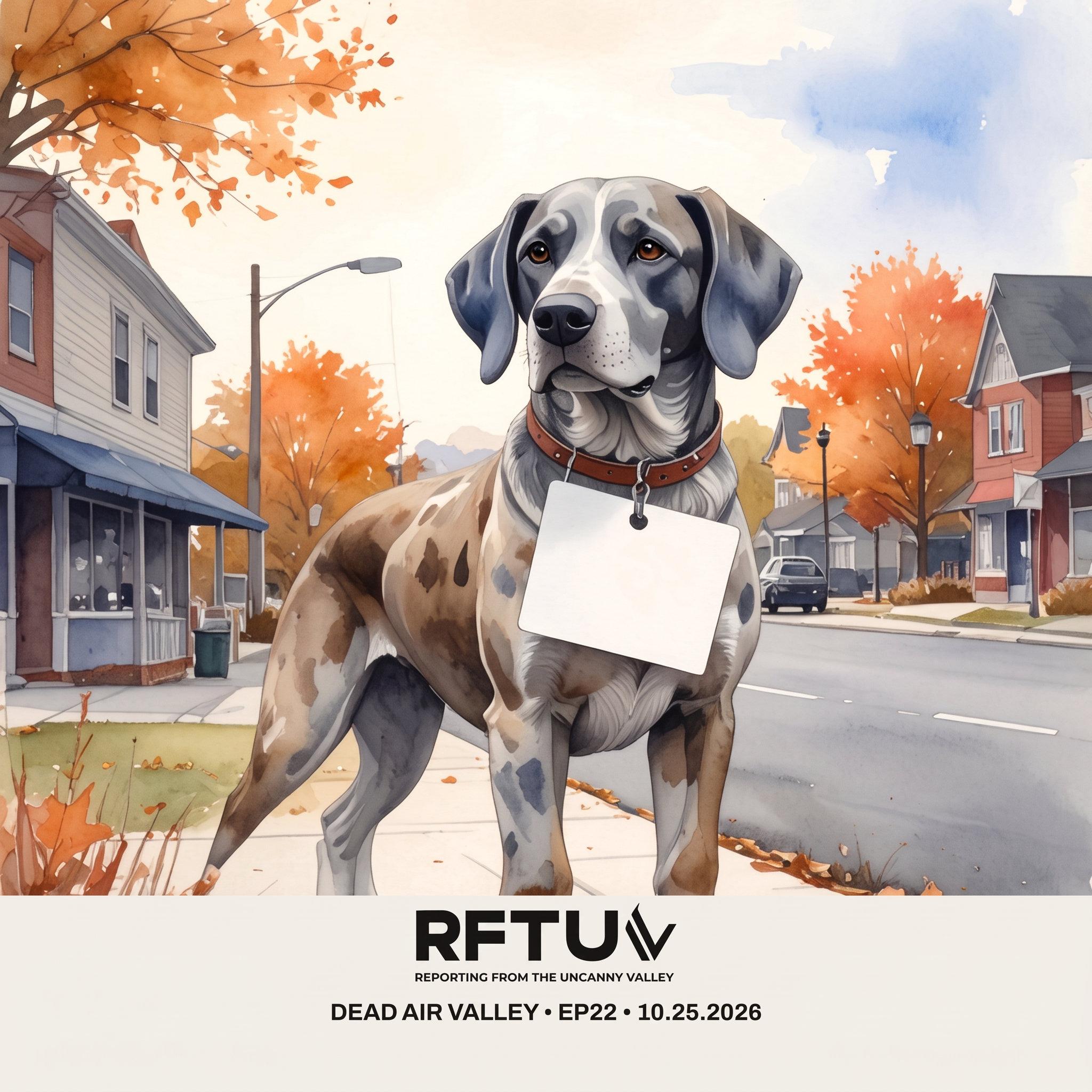

Dead Air Valley: "The Town Auctioned Its Dogs Today"
Dead Air Valley · By Reporting from the Uncanny Valley
Made with Rebel Audio Made with Rebel Audio
Follow the show
Paste this link into any podcast app to follow the show.
Show notes
Saugerties, NY auctioned 36 artist-decorated fiberglass dog statues on Sunday, October 25th, 2026, at the Barkin' Around Saugerties Auction, with proceeds helping fund a new Saugerties Animal Shelter building, among other causes. The shelter runs out of an old equipment garage next to the Route 212 transfer station, with one back room for quarantine. It has dealt with a ringworm outbreak in cats and kittens since May, which began with a crate of fourteen kittens. Dead Air Valley covers how three full-time and three part-time staff clean and contain the outbreak, and what executive director Ellie Monfette, cat coordinator Shallon Newkirk and shelter manager Morgan Bach say about it. The episode also explains what the new shelter building, expected in January, will change, plus auction ticket prices and how to foster, adopt or donate in Ulster County.
Timestamps
0:00 Saugerties auctions its 36 painted dogs
1:31 Past statue seasons and the 2026 dog display
3:01 Free preview at the Stone Pony Pavilion
4:14 Auction proceeds and the new shelter building
5:00 The shelter in an old equipment garage
7:08 Ringworm outbreak since May
8:59 Daily work and cleaning routine inside the shelter
11:48 Shallon Newkirk and the foster network
12:39 Worst kitten season in a decade
13:46 The new building under construction
15:18 How to attend, bid, foster, adopt or donate
16:19 Final thoughts on the dogs and the shelter
Transcript
ShowHide
0:00Dead Air Valley. The town auctioned its dogs today. Today in Saugerties, the town auctioned its dogs. None of them were alive. That is the whole situation, stated plainly, and it is worth sitting with for a moment before anything else. Thirty-six dogs, artist-decorated fiberglass statues, each one an individual object made by an individual artist, displayed through the warm months on the sidewalks of a village on the West Bank of the Hudson River in Ulster County, New York. They were photographed. They were walked past. They were used as meeting points and background details in other people's photographs. Then this afternoon, Sunday, October 25th, 2026, they were auctioned. At an event called the Barkin' Around Saugerties Auction, running from three in the afternoon to seven in the evening, the decorative dogs of
1:00the 2026 season went to whoever bid highest. The proceeds from that sale go toward helping fund a new animal shelter building, among other causes. Today in Saugerties, a town sold its painted dogs in part so that its real ones have somewhere better to live. We're going to look at that story closely. The surface. Saugerties has done this before, not with dogs specifically, but with the general idea. The town has run decorated statue seasons that have included horses, lighthouses, and butterflies. The format is familiar to anyone who has spent time in places that treat public space as an ongoing creative project. A local arts initiative or chamber program seeds the sidewalks and storefronts with a theme. Local and regional artists take on individual pieces, and the result is a season-long street-level exhibition that costs nothing to see and takes nothing to enjoy beyond the
2:03willingness to walk around and look. The 2026 season used dogs, thirty-six of them, each one unique. They turned up on the sidewalks as the season warmed up, and they stayed through the summer and into the fall, as that kind of public art tends to do, becoming background furniture in a town's daily life while remaining, if you looked directly at one, an object someone had genuinely made and cared about. That is the specific quality of a long-running street display. It becomes part of the peripheral vision. People stop noticing it the same way they stop noticing a particular bench or a familiar storefront sign, and that ordinariness is not failure. It means the object has been absorbed. It has become part of what the street feels like, which is exactly what a season-long installation is trying to accomplish. Before the auction, all the statues were gathered at a free
3:04preview at the Stone Pony Pavilion at 963 Kings Highway, which gave residents and visitors the unusual experience of seeing the entire pack in one place at one time. The full collection standing together in a pavilion is its own kind of image. Then they dispersed to the auction block. That part of the story is cheerful, and it is supposed to be. Street art seasons are community celebration. People walk past the same decorated statues dozens of times over months, and that repetition builds a kind of low-grade affection that has nothing to do with being asked to care about anything. Nobody is solicited. Nobody is handed a pamphlet. The engagement is entirely voluntary and entirely ambient, which is precisely what makes it an effective foundation for a fundraising event later. By the time the auction arrives, the town already has a relationship with the objects being sold, accumulated through
4:09daily proximity rather than manufactured by a campaign. The auction asks people to convert that feeling into a bid, and some of them do. They are also, in this case, fundraising mechanisms for something considerably less cheerful. The turn. The Barkin' Around Saugerties auction proceeds help fund the new Saugerties Animal Shelter building, among other causes. That qualifier matters. Not all of the money goes to the shelter. Some of it does, and the shelter needs it. A season of decorated dogs on public sidewalks generates goodwill before anyone asks for anything. The auction converts that goodwill into bids, and the building benefits from an affection built without solicitation. To understand why that matters, you need to see the shelter as it currently exists. The shelter as it is. The Saugerties Animal Shelter is operating out of an old equipment garage. That is not a
5:15euphemism or a shorthand for something slightly better than it sounds. It is an old equipment garage located next to the Route 212 transfer station, which is itself a facility for handling waste and recyclables. The building was not designed with animals in mind, and its limitations are not subtle. There is one back room available for quarantine. One room in a building that was built for entirely different machinery and entirely different purposes. Think about what that actually means for daily operations. Every animal that arrives at the shelter enters through a building that has no proper intake room, no architecture designed around the movement of sick versus healthy populations, and no ventilation system built to manage the air quality that close quarters animal care requires. The staff makes the building work because that is what the staff does, but the building is not helping
6:16them. Executive Director Ellie Monfette put it directly,"There's no real quarantine. It's an old equipment garage at the transfer station, so it wasn't built for a shelter." That is the facility the staff shows up to every day, and it is the facility in which every decision about animal care gets made under the constraints that the building imposes rather than the constraints that good shelter design would impose. The question of where to put a new arrival, how to separate a sick animal from a well one, how to keep air moving through a space that was built to hold equipment rather than living things, all of it runs through the same set of answers. One back room, one building never meant for this, and six people doing what six people can do in it. That is the facility that has been managing a ringworm outbreak since May. The outbreak. Ringworm is a contagious fungal skin infection. Despite the name,
7:21there is no worm involved. It spreads between animals and between animals and humans. It is difficult to contain in close quarters, and it is especially difficult to contain in a building with one back room serving as the only quarantine space. The Saugerties shelter's current outbreak began in May with a crate of fourteen kittens who were found on the side of a road and brought to the shelter. The infection spread to the other animals around June. The shelter has been managing it since. For context on how unusual this is, cat coordinator Shallon Newkirk noted that this is Saugerties' first ringworm outbreak in nine years. Nine years of running an animal shelter in a repurposed equipment garage without a dedicated quarantine room, and then one crate of kittens found by a roadside changes the season entirely. The shelter has responded by pausing some intake and most
8:22adoptions. That is not a small thing for a facility that exists to move animals through and out into homes. Some kittens remain available through off-site events rather than on-site visits, but the shelter has put a hold on on-site kitten adoptions and intake until further notice. The population on hand reflects the squeeze. Seven dogs, twelve cats, and two guinea pigs are on site, with fifty-three cats and kittens currently living in foster care rather than at the shelter. All seven dogs are ringworm-free and available for adoption. The daily work inside. Three full-time employees manage daily operations at the shelter, with help from three part-time employees. Six people in total working a building that was not designed for this purpose, with a population of animals that the outbreak has made more difficult to move. It is worth pausing on that math. Six
9:26people, a borrowed building, an active outbreak, a foster network stretched to absorb what the facility cannot hold, and a worst kitten season in a decade running underneath all of it. The cleaning protocol runs from the least infected animals to the most infected in sequence every day. The reasoning is containment. If you clean in the other direction, you risk carrying infection from the worst cases back into contact with the animals still holding on. Staff wear protective gear. They change gloves and gowns between animals. They run several air purifiers throughout the facility throughout the day. The sequence matters because in a building with one quarantine room and no dedicated intake space, sequence is one of the only tools available. You cannot rely on the architecture to keep populations separated, so you rely on order and routine, on the same steps followed the same way every morning,
10:28regardless of what else the day brings. You treat the routine itself as the barrier that the walls are not providing. That works, and the shelter has demonstrated it across five months of an active outbreak. But it requires the staff to be the infrastructure every single day in addition to everything else the job requires. Monfette described the rhythm of it."We start the minute we walk in the door." That is the whole day condensed into its first commitment. There is no easing in, no warm-up period. You walk in and you start cleaning, in sequence, in gear, working toward the animals who need the most attention. The protective gear, the gloves and gowns changed between animals, the air purifiers running. These are not extraordinary measures for an extraordinary moment. At this point, five months into the outbreak, they are just the job. They are the answer a small staff found to the
11:34question of how you run a shelter through a ringworm outbreak in a building that was not built to handle one, and they keep running that answer every day until the better building is ready. Shallon Newkirk, the cat coordinator, has taken ten cats home herself, adding to her own household in order to reduce the population at a facility that was never designed to hold the volume it is being asked to hold. She has also posted on social media seeking foster homes for cats that are free of ringworm. A few people responded and signed up after her posts. Regular foster families have continued to help. Fifty-three cats and kittens in the foster network is the result of that sustained effort. Newkirk was direct about what the staff has been trying to do. We're doing the best we can. I think most shelters actually shut down for several months completely, and we've gone above and beyond to get this
12:36season's kittens adopted. The harder season around it. The outbreak did not happen in an otherwise ordinary year. Staff said twenty twenty-six has brought the worst kitten season they have seen in a decade in terms of sheer volume of cats and kittens needing help. And adoptions were already running low before ringworm entered the picture. Shelter manager Morgan Bach offered one read on why. Housing costs, economic uncertainty, and the cost of veterinary care may be discouraging some families from adopting. That is Bach's stated view, attributed to Bach, and it fits a pattern visible at shelters across the region. The calculus of adopting a pet looks different when the basic costs of keeping a household together are already under pressure. The shelter is not the only place feeling that. Bach, at the close
13:37of a recent interview, said,"Any grace and patience that the public can afford us is deeply appreciated." The building ahead. There is a new building under construction. It is expected to be completed in January. Shelter officials have raised three and a half million dollars for the project and need about two and a half million more. The new building will actually provide a dedicated quarantine area, updated ventilation, an intake room with its own entrance so staff can examine new arrivals before those animals come into contact with any of the animals already on site, and slightly more space overall. The current building makes the list feel specific rather than abstract. That last item, slightly more space, is the one that probably registers least dramatically from the outside. It is also probably the one that registers most from the inside. At the end of a cleaning shift in a repurposed
14:38equipment garage next to a transfer station, having changed gloves and gowns between every animal, air purifiers running, one back room holding the quarantine that the building was never designed to support. A dedicated intake entrance changes the math on an outbreak like the one that started in May. If new arrivals can be assessed in a separate room before contact with the existing population, a crate of kittens found by the road does not automatically become a six-month containment situation. The new building does not solve everything. Slightly more space and better ventilation and a proper quarantine area are not infinite resources. But they are the difference between a facility built for animals and a facility that is doing its best in a building built for something else entirely. The practical close. If you are in or near Saugerties today, the Barkin' Around Saugerties auction is running
15:43from three in the afternoon to seven in the evening. Tickets are thirty-five dollars in advance and forty dollars at the door. Tickets are available at Smith Hardware, Town & Country Liquors, and online at discoversaugerties.com, where you can also view the dogs and bid online. The auction proceeds help fund the new shelter building, among other causes. Beyond the auction, residents can apply to foster cats that are ringworm-free, adopt eligible kittens at off-site events, donate toward the new building, or buy an engraved brick for its entrance. All the links and addresses are in the show notes. Final beat. The dogs that spent the season on the sidewalks of Saugerties will leave today with whoever outbid everyone else for them. They will go to gardens, porches, shop corners, backyards. They will become yard art, conversation pieces, permanent residents of someone's personal space. They will be
16:43photographed in new contexts, and eventually they will become ordinary, as objects do when they live somewhere long enough. The animals they were sold for are still in a repurposed equipment garage next to a transfer station, or in foster care with families across the area who said yes when Shallon Newkirk asked. They are waiting for a building with a room of their own, a proper entrance for the ones who come in off the street in crates, and ventilation that was installed with animals in mind. That building is on its way. That is the exchange rate. Painted dogs traded against a quarantine room. A town decorates its streets in summer and auctions what it decorated in fall. And the proceeds become, in part, a contribution towards something that should not have taken this long to build, but is being built now, one bid at a time. Silas Van Wyck for Dead Air Valley. The show notes have everything
17:48you need.